Hanway Investors Assess Dormant Pwalugu Tomato Factory For Possible Revival
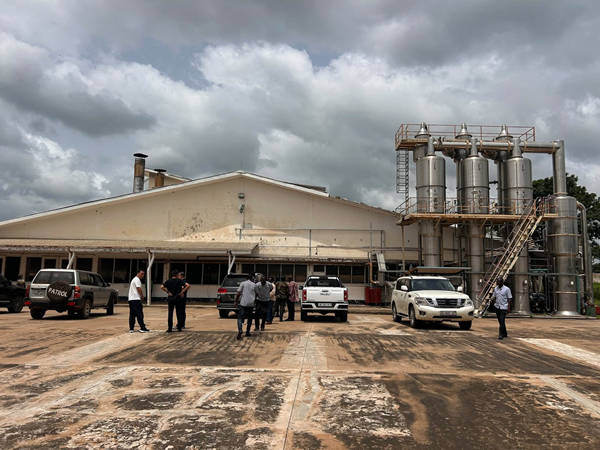 The government is exploring a potential investment partnership with Chinese company Hanway International Investment Limited to revive the dormant Pwalugu Tomato Factory in the Upper East Region.
Upper East Regional Minister, Akamugri Donatus Atanga, led a delegation from the company, headed by its Chief Executive Officer, Cui Yongzhi, on a tour of the factory in the Talensi District and nearby agricultural lands along the White Volta.
The visit formed part of preliminary discussions on the possible rehabilitation of the facility, which has remained non-operational since 2013.
The discussions focused on restoring the factory’s production capacity, establishing a canning facility on-site and ensuring a reliable supply of raw materials to support sustained operations.
Mr Atanga explained that when the factory was operational, tomato paste was processed and placed in drums before being transported to Tema in the Greater Accra Region for canning.
He said the government wanted the canning stage to be undertaken at Pwalugu if the factory was revived, eliminating the need to transport semi-processed products over long distances before packaging.
“So we want to now establish the canning here. So that when we come here, you can it. And we need to supply to the market and export,” he said.
The proposed arrangement is expected to streamline production, reduce transportation requirements and improve the factory’s ability to supply both domestic and export markets.
The regional minister also urged the prospective investors to consider processing other agricultural products to ensure year-round operations and reduce dependence on tomatoes alone.
He identified onions, pepper, garden eggs, beans and dawadawa jam as some of the products that could potentially be processed at the facility.
“Not necessarily tomato paste alone. You can do onions. You can do pepper. You can do garden eggs. You can do beans. You can do dawa-dawa jam, so that it will be all year round,” he told the investors.
Mr Atanga said the government was also interested in improving agricultural productivity by increasing both the quantity and quality of crops produced by farmers in the area.
“The government wants to improve on the first step. That is improving the quantities, and the quality of production,” he said, adding that the objective was to enable farmers to produce more from the same acreage.
As part of the tour, he took the delegation to agricultural lands on both sides of the White Volta, which could potentially support large-scale tomato cultivation and provide raw materials for the factory.
A consistent supply of tomatoes and other crops would be critical to the success of any rehabilitation plan.
Mr Atanga highlighted the potential benefits of establishing a canning facility at Pwalugu, particularly in extending the shelf life of processed products and reducing losses associated with prolonged storage.
He explained that the previous practice of storing tomato paste in drums, with salt added to prevent fungal growth, could still expose the product to spoilage if it remained in storage for extended periods.
He said canning the products at the factory would help preserve them for longer periods, making it easier to supply markets and explore export opportunities.
The minister also pointed to Pwalugu’s proximity to neighbouring countries, including Burkina Faso, Togo and Mali, as an advantage for reaching regional markets.
He said a revived factory could serve as a processing and distribution hub for tomato products and other agricultural produce across Ghana and the wider West African sub-region.
The regional minister further proposed that government-backed institutional procurement could provide a ready market for products manufactured at the facility.
He suggested that schools and hospitals operating under government feeding arrangements could be encouraged to source processed tomato products from the factory.
“The government will take a position to let you supply all the schools, all hospitals, where government is feeding,” he said.
He added that the factory could also target the general market as part of efforts to reduce Ghana’s dependence on imported tomato products.
Describing the proposal as an import-substitution initiative, Mr Atanga said locally manufactured products could benefit from policies designed to support domestic production and make local processing more competitive.
Mr Atanga also raised the possibility of tax waivers on machinery and equipment that Hanway International Investment Limited might import for the proposed rehabilitation.
He asked the company to identify the equipment needed for the project, indicating that he would engage the government on possible tax relief to facilitate the investment.
“So when you want to import your equipment, the equipment that you are going to bring here, and then produce this one, they will give you tax waiver,” he told the delegation.
He said discussions with the government would follow once the company provided details of the machinery and equipment required to restore the factory.
The proposed revival of the Pwalugu Tomato Factory could create opportunities for farmers, support agro-processing, reduce post-harvest losses and create jobs in the Upper East Region.
-Overseeronline.com















Post Comment